
GOWGANDA SILVER TAILINGS
2.814 Million Ounces of Indicated Silver, Already at Surface
Nord's Gowganda Silver Tailings Project hosts an Indicated Mineral Resource of 1,845,000 tonnes grading 47.4 g/t silver, containing 2,814,000 ounces of silver, at a 10 g/t silver cut-off. The estimate was prepared by GeoVector Management Inc. with an effective date of August 1, 2026 and covers the Main Tailings, South Tailings and two outflow domains. Nord's acquisition of four historic mining leases from Battery Mineral Resources, completed March 31, 2026, brought the principal tailings deposits and adjacent infrastructure under a single operator for the first time in the district's history.
Duncan Studd, M.Sc., P.Geo., of GeoVector is the independent Qualified Person responsible for the estimate. Mineral resources that are not mineral reserves do not have demonstrated economic viability. See the September 15, 2026 news release and the notes below.
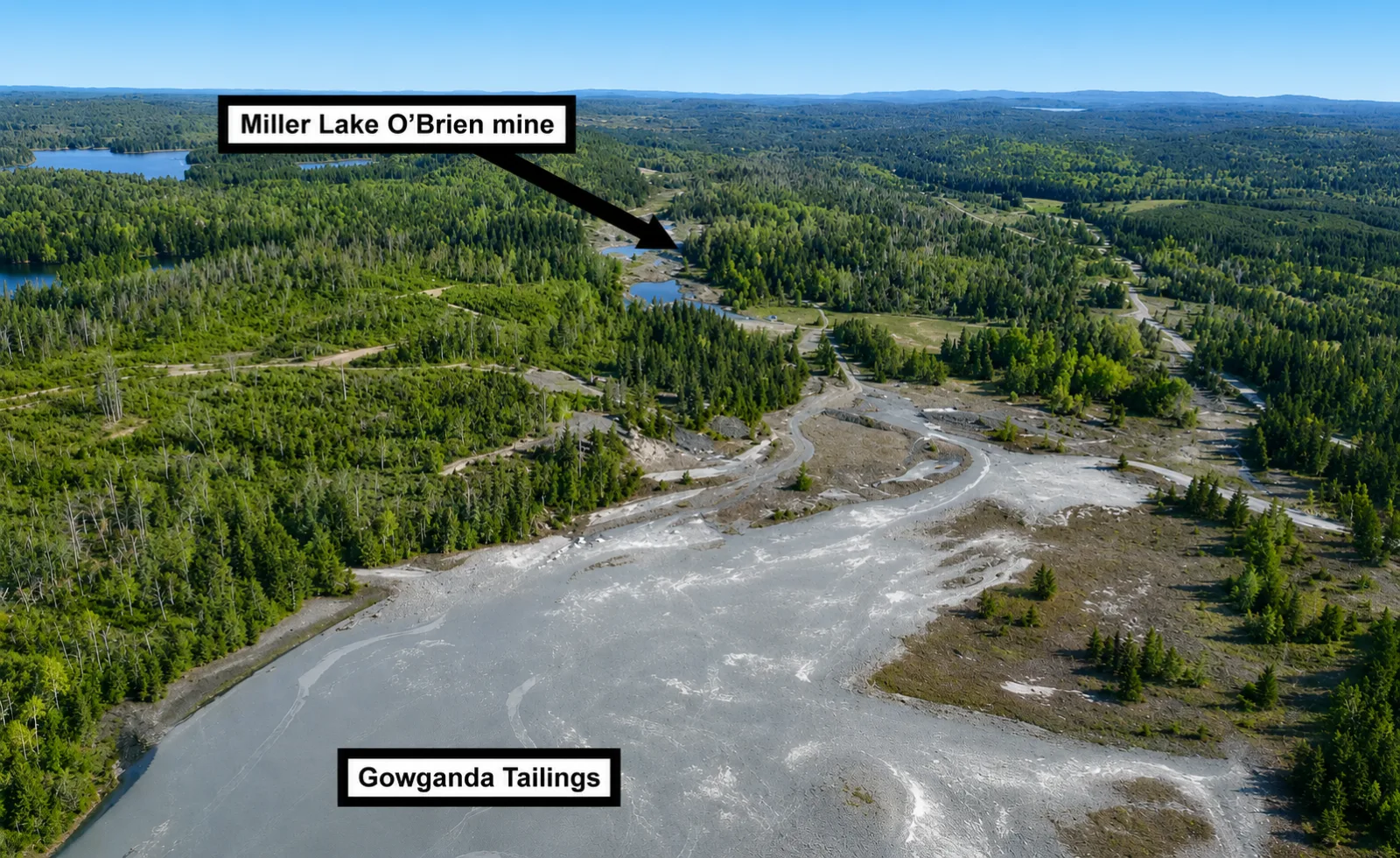
REGIONAL CONTEXT
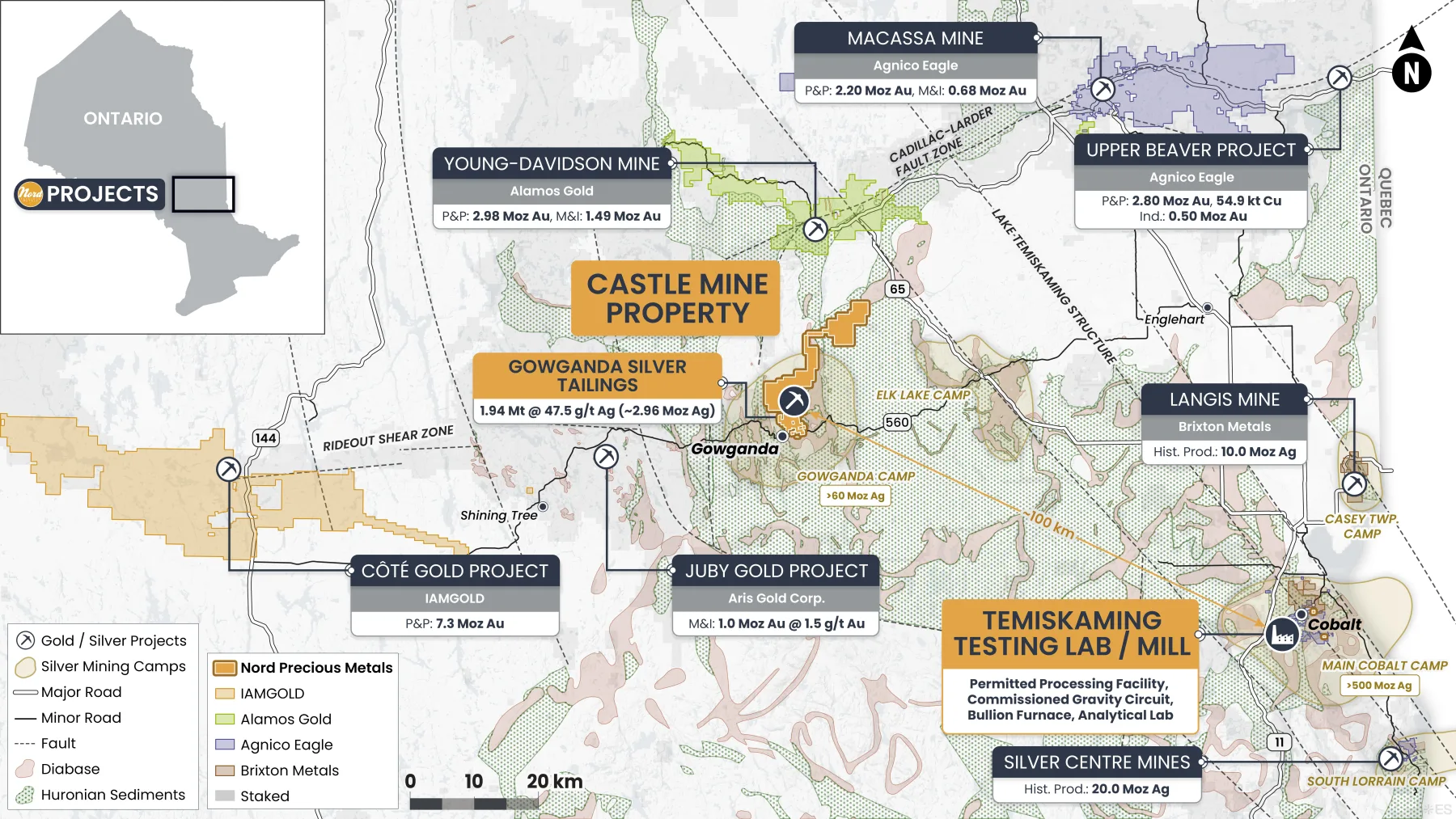
The Cobalt-Gowganda Silver District
The broader Cobalt-Gowganda district has produced over half a billion ounces of silver since 1903. The Cobalt Camp proper accounts for approximately 460 million ounces. The Gowganda satellite camp, 50 km to the west, contributed over 60 million ounces, principally from the Miller Lake O'Brien and Siscoe operations between 1910 and 1972.
The Gowganda tailings sit adjacent to Nord's Castle Mine property, approximately 100 km west of TTL Laboratories in the town of Cobalt. The surrounding region hosts Agnico Eagle's Macassa and Upper Beaver projects, Alamos Gold's Young-Davidson mine, and IAMGOLD's Côté Gold, placing Nord's silver assets within one of northeastern Ontario's most actively mined corridors.
TECHNICAL WORK
Four Decades of Drilling, Sampling, and Engineering
The Gowganda tailings have been sampled and studied since 1981 by a succession of operators and consultants. The 2026 estimate draws on 2,898 metres of auger, drive-pipe and sonic drill-hole samples from campaigns in 1981, 1986, 2000, 2011 and 2018, verified by GeoVector's July 2026 site visit and independent check sampling at ALS Geochemistry in North Vancouver. Historical data cannot be fully verified, but the consistency of assay grades across multiple sampling campaigns serves as a reasonable control on accuracy.
1981
Watts, Griffis and McOuat
545 auger and 26 drive-pipe holes (1,570 m). Cyanide-leach testwork at Lakefield Research.
1986 to 1987
Kilborn Limited
152 sonic holes (910 m). Feasibility study. Historical; its economic analysis predates NI 43-101 and is not current.
2000
Sandy K Mines
32 sonic holes in the core area.
2007 to 2011
Temex Resources and GeoVector
Met-Solve thiosulphate testwork (2007). NI 43-101 technical report and resource estimate (2011), now superseded by the 2026 estimate.
2018
Battery Mineral Resources
103 sonic holes with multi-element sampling.
2026
Nord and GeoVector
Updated Mineral Resource Estimate, effective August 1, 2026: Indicated 1,845,000 t at 47.4 g/t Ag containing 2,814,000 oz. July 2026 site visit and independent sampling. Supporting technical report to be filed on SEDAR+.
MINERAL RESOURCE ESTIMATE, AUGUST 2026
Indicated Mineral Resource of 2.814 Million Ounces of Silver at 47.4 g/t
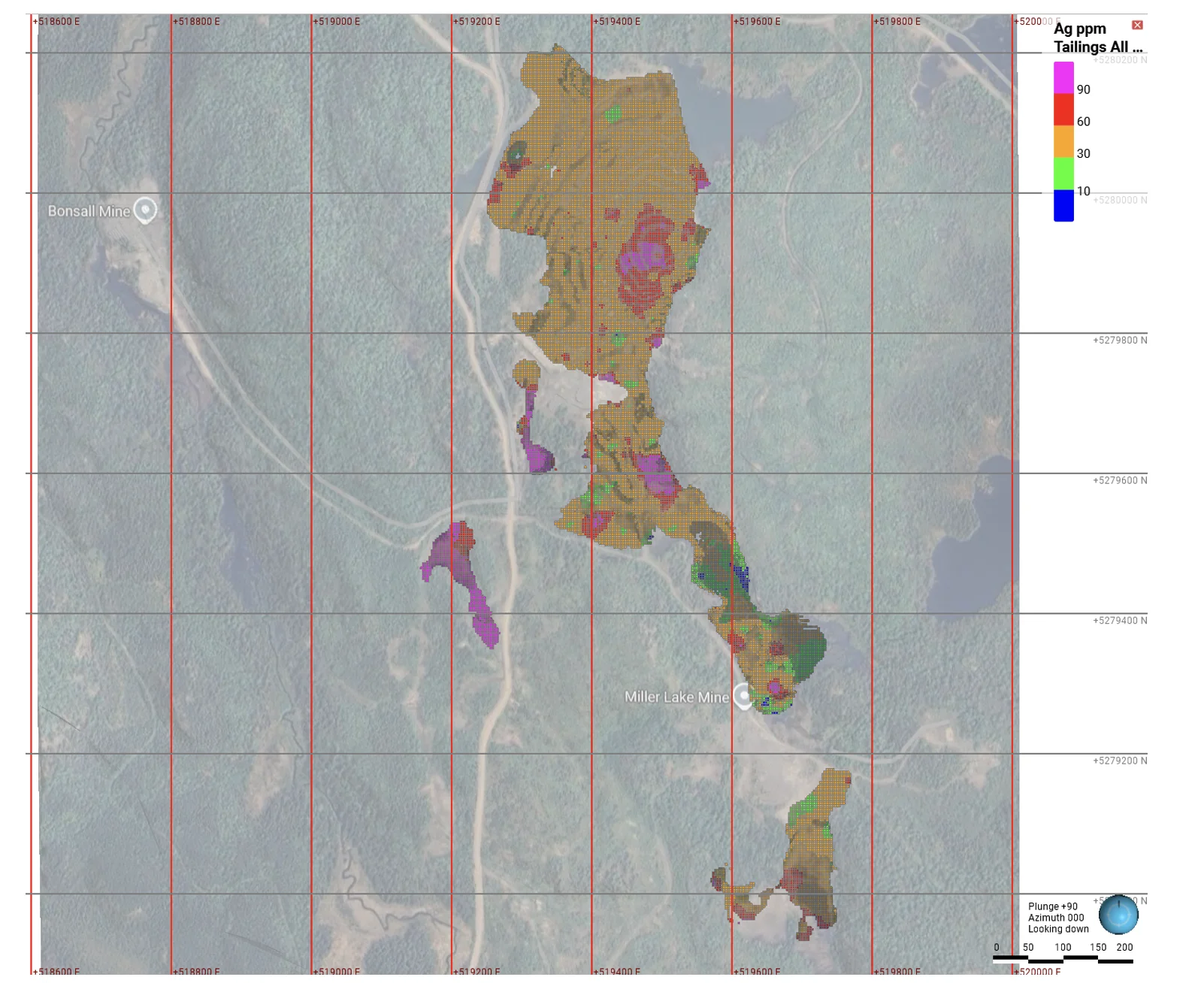
GeoVector integrated historical drilling and subsequent drilling by previous operators with updated surface information and a three-dimensional model of the tailings base. The estimate covers the Main Tailings, South Tailings and two outflow domains.
Table 1. Gowganda Tailings Mineral Resource Estimate. Effective August 1, 2026. Base case cut-off 10 g/t Ag.
| Domain | Resource class | Tonnes | Silver grade (g/t) | Contained silver (oz) |
|---|---|---|---|---|
| Main Tailings | Indicated | 1,762,000 | 46.3 | 2,622,000 |
| South Tailings | Indicated | 52,000 | 42.9 | 72,000 |
| Outflow One | Indicated | 10,000 | 96.5 | 31,000 |
| Outflow Two | Indicated | 21,000 | 134.0 | 89,000 |
| Total | Indicated | 1,845,000 | 47.4 | 2,814,000 |
- Domain
- Main Tailings
- Resource class
- Indicated
- Tonnes
- 1,762,000
- Silver grade (g/t)
- 46.3
- Contained silver (oz)
- 2,622,000
- Domain
- South Tailings
- Resource class
- Indicated
- Tonnes
- 52,000
- Silver grade (g/t)
- 42.9
- Contained silver (oz)
- 72,000
- Domain
- Outflow One
- Resource class
- Indicated
- Tonnes
- 10,000
- Silver grade (g/t)
- 96.5
- Contained silver (oz)
- 31,000
- Domain
- Outflow Two
- Resource class
- Indicated
- Tonnes
- 21,000
- Silver grade (g/t)
- 134.0
- Contained silver (oz)
- 89,000
- Domain
- Total
- Resource class
- Indicated
- Tonnes
- 1,845,000
- Silver grade (g/t)
- 47.4
- Contained silver (oz)
- 2,814,000
Source: GeoVector Management Inc., September 2026.
Notes to the mineral resource estimate
- The effective date of the Gowganda Tailings MRE is August 1, 2026.
- Duncan Studd, M.Sc., P.Geo. of GeoVector is responsible for the Gowganda Tailings Mineral Resource Estimate and is an independent Qualified Person as defined by NI 43-101.
- The classification of the current MRE into Indicated mineral resources is consistent with the 2014 CIM Definition Standards for Mineral Resources and Mineral Reserves.
- All figures are rounded to reflect the relative accuracy of the estimate and numbers may not add due to rounding.
- The mineral resource is presented undiluted and in situ, constrained by a 3D grade control resource model, and is considered to have reasonable prospects for eventual economic extraction. The mineral resource is exclusive of mined out material.
- Mineral resources which are not mineral reserves do not have demonstrated economic viability.
- The Mineral Resource Estimate for the Gowganda Tailings is based on a validated database of sonic, auger, direct push drill holes, and 3D resource models constructed in Leapfrog Geo 2026.1.2. Grades for Ag are estimated for each mineral resource domain using 1.5 m capped composites assigned to that domain. To generate grade within the blocks, the inverse distance squared (ID2) interpolation method was used for all domains.
- Based on the manner of deposition, location, size, shape, and orientation, it is envisioned that the Gowganda Tailings may be recovered using surface mining methods. Mineral resources are reported at a base case cut-off grade of 10 g/t Ag. The in-pit resource grade blocks are quantified above the base case cut-off grade, above the constraining tailing base, below topography and overburden and within the constraining mineralized domains (the constraining volumes).
- The base case cut-off grade considers a silver price of US$65/oz and an overall operating-cost assumption of C$17/t, drawn from a published Ontario tailings benchmark. These assumptions were used to establish the resource reporting cut-off; they do not constitute an economic study. Gowganda-specific capital and operating costs remain to be established through further engineering and economic work.
- The base case cut-off grade considers a silver recovery of 81.6%, based on the 2007 Met-Solve report.
- The estimate of Mineral Resources may be materially affected by environmental, permitting, legal, title, taxation, socio-political, marketing, or other relevant issues.
- As of the effective date of the MRE, the QP is not aware of any known environmental, permitting, legal, title-related, taxation, sociopolitical, or marketing issues or any other relevant issue that could materially affect the Gowganda Tailings MRE.
Modelling and assumptions
GeoVector used inverse distance squared interpolation of 1.5-metre composites, with silver grades capped at 250 g/t, in a block model with blocks measuring 3 metres by 3 metres by 1 metre. A density of 2.12 tonnes per cubic metre was applied, calculated for the 2011 estimate from historical specific-gravity measurements and the logged proportions of sandy and slimy material. GeoVector considers that calculation reasonable and recommends new specific-gravity measurements to verify the density assumption. The Lower Bonsall area was excluded from the reported resource because of a flowing stream and revegetation.
Further testwork and engineering will determine the processing route and project economics; the resource cut-off assumptions are not a forecast of recoverable ounces.
Prior estimate. GeoVector's NI 43-101 technical report of July 8, 2011, prepared for Temex Resources, reported an earlier Indicated resource for these tailings. That estimate is superseded by the August 1, 2026 estimate above, is no longer treated as current, and should not be relied upon.
The supporting NI 43-101 technical report will be filed under Nord's profile on SEDAR+ within 45 days of the news release.
ACQUIRED LEASES & GEOLOGY
Past Producers Within a Single Contiguous Land Package
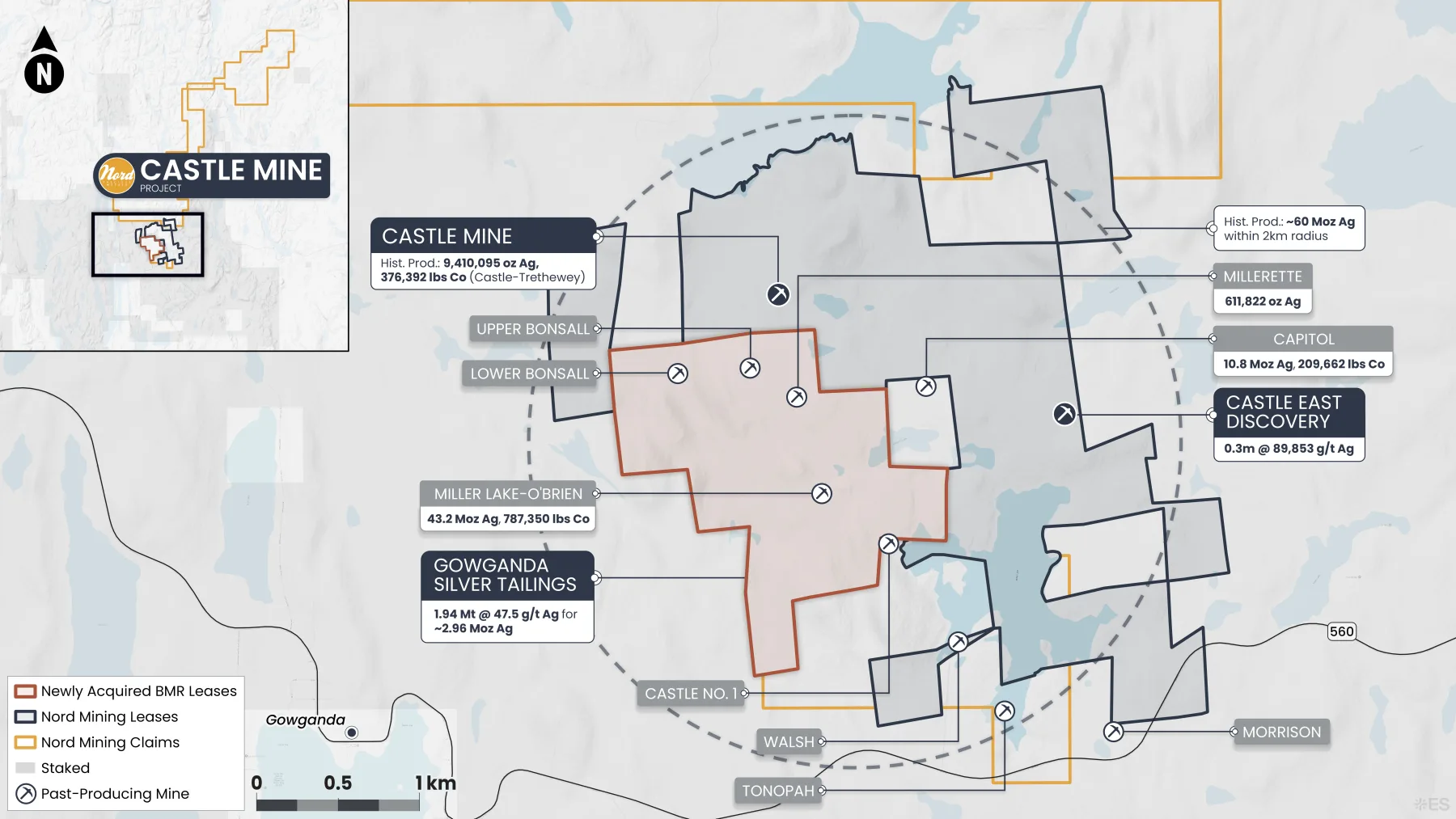
The newly acquired BMR leases consolidate four historic past producers — including Miller Lake-O'Brien, Millerett, and Bonsall — onto a single contiguous land package adjacent to Nord's existing Castle Mine and Castle East discovery. All deposits are hosted in the same Nipissing diabase-hosted, native-silver vein system that defines the broader Cobalt-Gowganda camp.
PAST PRODUCTION
Combined historical output exceeds 53 million ounces of silver
Across four contiguous past producers now under Nord's control — Castle-Trethewey, Miller Lake-O'Brien, Millerett, and Bonsall — historical silver production exceeds 53 million ounces. For the first time in the district's history, this production base sits under a single operator, with proximate access to Nord's Castle Mine workings, the Temiskaming Testing Lab in Cobalt, and the Company's planned 600 TPD modular gravity plant — creating one consolidated platform for the next round of resource definition and recovery work.
43,200,000
Miller Lake-O'Brien (oz Ag)
9,410,095
Castle-Trethewey (oz Ag)
611,822
Millerett (oz Ag)
600,000
Bonsall (oz Ag)
Historical production figures compiled from Ontario Geological Survey and operator records. Historical production is not indicative of any current mineral resource or reserve.
PROCESSING STRATEGY
Process Selection Follows the Resource
The updated estimate anchors the next phase of work: selecting a recovery process, developing the engineering design and establishing project economics alongside permitting. Nord's metallurgical program is focused on evaluating concentration options and characterizing the resulting products and residual tailings. These results will guide process selection, engineering, water management and economic evaluation.
The 2007 Met-Solve program for Temex reported silver extraction of up to 82% into a sodium thiosulphate solution and subsequent recovery of silver from solution, yielding an overall recovery of up to approximately 81.6%. GeoVector used that historical laboratory result in the updated estimate. Nord is pursuing new metallurgical studies that may use a different processing method, and the resource cut-off assumptions are not a forecast of recoverable ounces.
Silver products from Gowganda may be refined at the Company's TTL facility in Cobalt, Ontario, which maintains furnace capacity for silver doré. Residual tailings and products will be characterized as part of the same program.
District Processing Infrastructure
Beyond the Gowganda tailings, Nord maintains processing infrastructure that serves the broader Cobalt-Gowganda district. TTL Laboratories is the only permitted high-grade milling facility in the Cobalt Camp, operating gravity circuits, a furnace, and an assay laboratory. The Company's 600 TPD modular gravity plant awaits commissioning under the recovery permit framework.
These facilities are designed for feed sources where the silver mineralogy is amenable to gravity concentration. Testwork on Beaver Mine tailings has produced commercial-grade high-grade silver concentrate via gravity recovery (October 6, 2025 press release), confirming that certain district tailings and waste rock streams can be processed through existing equipment. Historical underground workings across the consolidated property also contain broken ore material in stopes that was never hoisted to surface. This material, if quantified through sampling, would represent an additional gravity-amenable feed source.
The phased approach — gravity processing of amenable district materials through existing infrastructure, concurrent with process selection and engineering for the Gowganda tailings — supports advancing the Gowganda tailings project through permitting and technical evaluation, with each processing route serving the feed source for which it is metallurgically suited.
PATH FORWARD
Next Steps
Completed August 2026
Updated Mineral Resource Estimate
Indicated 1,845,000 t at 47.4 g/t Ag containing 2,814,000 oz, effective August 1, 2026, prepared by GeoVector Management Inc. The supporting NI 43-101 technical report will be filed on SEDAR+ within 45 days of the September 15, 2026 news release.
Permitting
Recovery Permit
Advancing under Ontario's 80-day fast-track framework. Specialist permitting consultants and T-Engineering (environmental compliance and paste backfill engineering) are engaged. The Ontario Ministry of Mines has provided an advanced template and confirmed the regulatory pathway.
Underway
Metallurgical Testwork
Tailings samples have been collected. Testwork is evaluating concentration options and characterizing the resulting products and residual tailings, to guide process selection, engineering, water management and economic evaluation.
Next phase
Toward a development decision
With the updated estimate in hand, the Company is advancing process selection, engineering design and project economics alongside permitting. These steps are intended to advance Gowganda toward a development decision, starting with material already at surface.
KEY DOCUMENTS
Technical References
SEPTEMBER 15, 2026
News release: Updated Gowganda Tailings Indicated Mineral Resource of 2.814 Million Ounces of Silver at 47.4 g/t
2026
NI 43-101 Technical Report, GeoVector Management Inc.
Filing pending on SEDAR+.
SEDAR+ • JULY 2011
NI 43-101 Technical Report — GeoVector / Temex Resources
Superseded by the August 1, 2026 estimate